

- HOME
- Research
- Researcher's Profile
- Takuya HARA
Researcher's Profile

- Associate Professor
- Takuya HARA
- Space Environment and Planetary System Science
- thara
 g.ecc.u-tokyo.ac.jp
Biography
| March 2009 | Graduated from School of Science, Nagoya University |
|---|---|
| April 2012 | Resarch Fellowship for Young Scientist (DC2), JSPS |
| March 2014 | Doctorate in Science (Physics), Graduate School of Science, Nagoya University |
| April 2014 | Solar-Terrestrial Environment Laboratory, Nagoya University, Collaborated Researcher |
| May 2014 | Space Sciences Laboratory, University of California Berkeley, USA, Postdoctoral Researcher |
| March 2018 | Space Sciences Laboratory, University of California Berkeley, USA, Assistant Research Physicist |
| September 2026 | Research Center for Advanced Science and Technogy, The University of Tokyo, Associate Professor |
Research Interests
Although Mars lacks a global intrinsic magnetic field, the localized and asymmetric crustal magnetic fields are primarily distributed in the southern hemisphere. Atmospheric escape into space induced by the solar wind interaction with Mars has been revealed by direct in-situ spacecraft observations over the past several decades. This process may have played an important role in the evolution of the Martian atmosphere and climate.
My research focuses on the dynamics of the Martian plasma environment and the mechanisms of atmospheric escape associated with solar wind interactions with Mars. I have investigated these processes using plasma measurements from instruments aboard ESA’s Mars Express and NASA’s Mars Atmosphere and Volatile Evolution (MAVEN) spacecraft.
I am currently involved in NASA’s Escape and Plasma Acceleration and Dynamics Explorers (ESCAPADE) mission, which uses two identical small orbiters to conduct simultaneous multipoint measurements of the Martian plasma environment (see, Figure 1). ESCAPADE aims to investigate the spatiotemporal variability of the Martian hybrid magnetosphere and ionosphere, which is difficult to disentangle using observations from a single spacecraft, and to characterize their real-time responses to upstream solar wind variations. I serve as the Science Data Lead, responsible for developing the science data processing and analysis pipeline. ESCAPADE launched in November 2025 and is scheduled to enter Mars orbit around September 2027.
Japan’s Martian Moons eXploration (MMX) mission is also expected to reach the Martian system around the same period. If these missions proceed as planned, up to six spacecraft from multiple international missions may simultaneously observe the Martian plasma environment in the late 2020s.
Building on my knowledge and experience I have gained through participation in international Mars exploration missions, I aim to maximize the scientific return from this exciting new era of simultaneous multipoint observations of the Martian plasma environment.
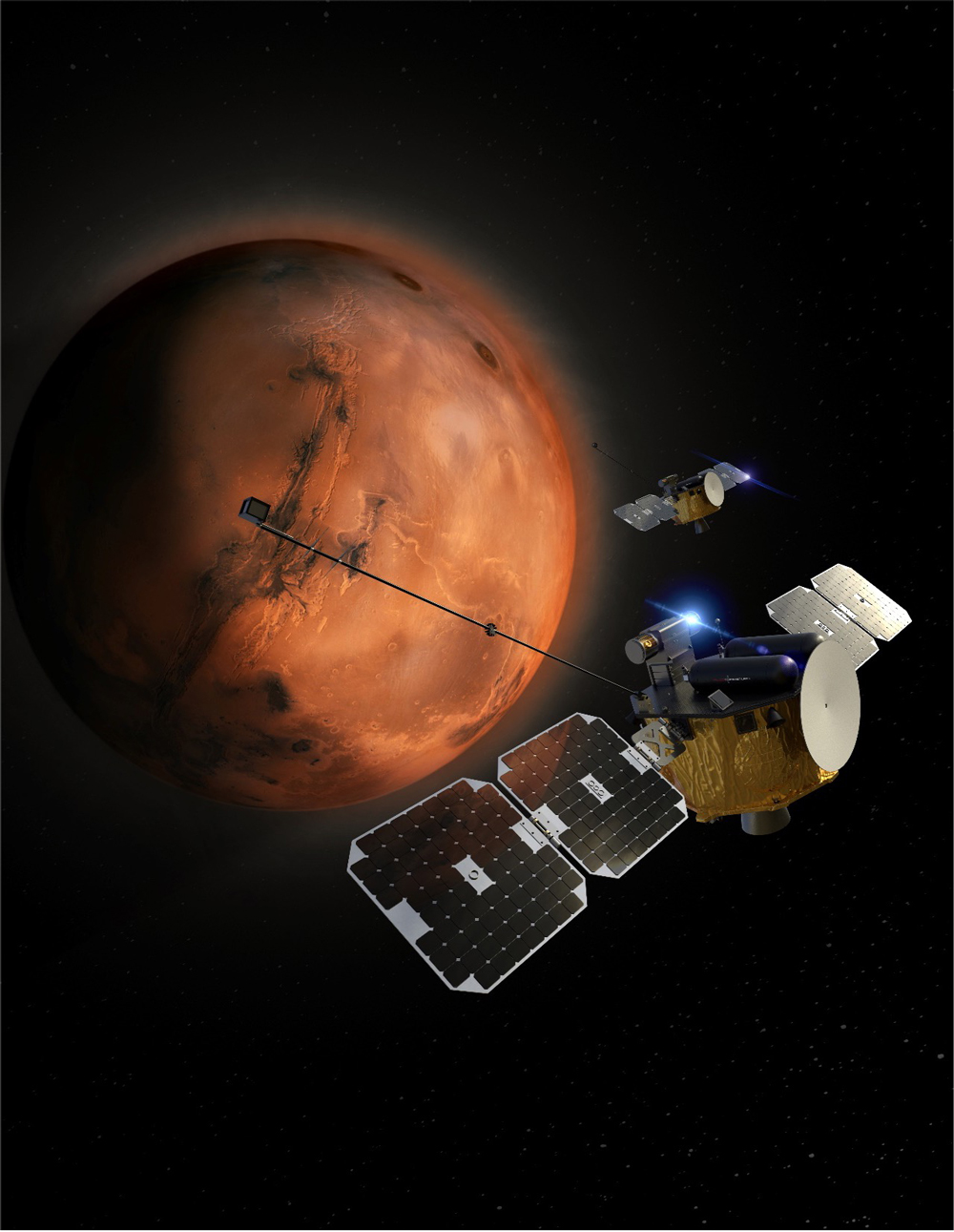
- Figure 1: ESCAPADE (courtesy of Rocket Lab)
Award
- 2011 SGEPSS Student Presentation Award (Aurora Medal)
- March 2016 NASA Robert H. Goddard (RHG) Exceptional Achievement for Science, MAVEN Science Team
- June 2016 NASA Group Achevement Award, MAVEN Science Team
- August 2018 NASA Group Achevement Award, MAVEN Science Team
Keywords
Planetary Magnetosphere and Ionosphere Physics, Solar Wind Interaction with Mars, Unmagnetized Planet
Educational Systems
- Department of Earth and Planetary Science, Graduate School of Science
