

- HOME
- Research
- Research Category
- Initiatives for Co-Creation of Inclusive Societies(Science of Embodiment)Tamesue Laboratory
Initiatives for Co-Creation of Inclusive Societies(Science of Embodiment)
Tamesue Laboratory
Play Unlocks Human Potential
Our laboratory seeks to open up human potential through play and to realize an inclusive society. We touch the world through the body; the body gives rise to emotion; and within that felt response we shape the sense of "I." The advance of AI has transformed the value of gathering and analyzing knowledge—but seen from another angle, AI has carved out and revealed the part of "intelligence" that can be extracted even once it is separated from the body.
As we go on living, the relationship between body and environment becomes fixed—locked in—into particular patterns. The same dynamic underlies many of society's challenges: rigidified roles and relationships, the difficulty of living, isolation, and division. Play has the power to loosen that fixity for a moment and to re-weave the bonds between body and world, and between one person and another.
At present, we are creating settings where physical play transforms relationships—such as a “UNDOKAI” held at the Echigo-Tsumari Art Triennale, which brings together a jumbled mix of people of diverse races and backgrounds. Going forward, through research on walking and running and other forms of physical play, we will examine how the relationships between people, and the way we grasp the world, come to change.
Evaluating anything requires a measure—yet a measure always reduces matters to "superior or inferior." Play shakes that measure itself, opening room for new values to emerge. By grasping forms of value distinct from achievement, we aim to build—through both research and practice—the foundations of an inclusive society in which diverse bodies are never fixed in a position of inferiority.
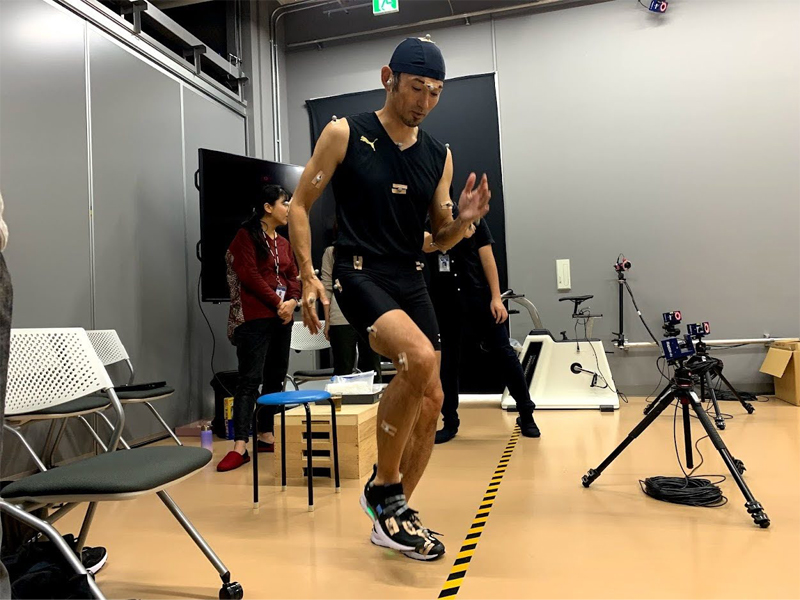
Analyzing running motion
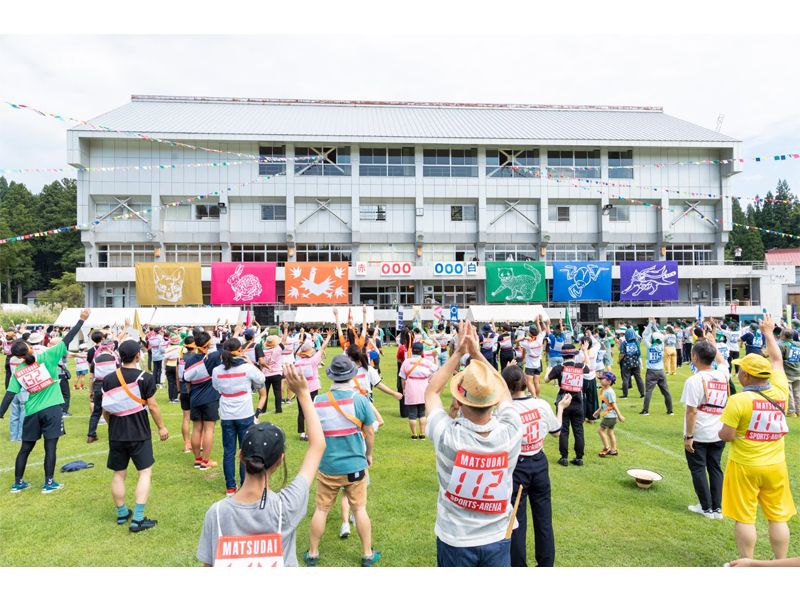
Echigo-Tsumari Art Triennale "Undokai"
photo by Osamu Nakamura
For about twenty-five years, I lived in the world of competitive sport. In sport, improvement generally comes through the repeated practice of training. Yet as one becomes more skilled, there are moments when one begins to feel confined within a particular movement pattern. One does not become worse, but neither does one become better. It is as if the body has become locked in, and no matter what one tries, no real change occurs.
And yet, after struggling in this state for some time, a small and unexpected trigger can sometimes lead to a sudden leap in technique. What, then, is this trigger? I am interested in why such “lock-in” occurs not only in sport, but also in culture, society, and many other domains, and in how new developments can emerge from within it.
By examining these moments of stagnation and transformation, I hope to explore how people, bodies, and communities can move beyond fixed patterns and open themselves to new possibilities.
Member
-
- Professor
Dai TAMESUE
Research Area:Inclusive Education, Sports, and Assistive Technology - Professor
<As of July 2026>
Tags
