

- HOME
- NEWS
- RCAST Report
- AY2026 Autumn Semester Diploma Presentation of Advanced Interdisciplinary Studies
AY2026 Autumn Semester Diploma Presentation of Advanced Interdisciplinary Studies
- RCAST Report
September 25, 2026
On Friday, September 18, the AY2026 Autumn Semester Diploma Presentation of Advanced Interdisciplinary Studies was held in the auditorium on the third floor of RCAST Building 13.
Professor Yasuyuki OZEKI (Photonic Imaging), Director of Managing Committee, Department of Advanced Interdisciplinary Studies, Graduate School of Engineering, The University of Tokyo, offered his heartfelt congratulations to the graduates.
Prof. Ozeki noted that the graduates had each “pursued an original question, faced uncertainty and difficulties, and created new knowledge” through their doctoral research. Referring to the extraordinary range of subjects covered by their dissertations, he pointed out that, although the subjects may seem very different at first glance, the systems they had studied “do not remain still.” Their conditions and shapes change, and the information available about them is often incomplete. He described their task as discovering meaningful patterns within this complexity and developing new ways of understanding and responding to change.
Turning to artificial intelligence, Prof. Ozeki said that AI(Artificial Intelligence) is changing the way we learn, conduct research, and make decisions, and can analyze vast amounts of information and generate answers with remarkable speed. “When answers can be produced almost instantly, the ability to formulate the right questions becomes even more valuable.” He emphasized the importance of judging whether an answer is reliable, recognizing the assumptions behind it, connecting it with knowledge from other fields, and considering how it should be used. “AI can support our thinking, but it does not remove our responsibility to think and make judgments for ourselves.”
He also told the graduates that during their doctoral studies, they had learned not only how to answer difficult questions, but also how to identify “questions worth asking.” Research rarely proceeds exactly as planned, he noted, and an unexpected result is not necessarily a failure. It may show that our assumptions need to change, or it may lead to a more important discovery.
Prof. Ozeki encouraged the graduates to “continue to approach the unknown with curiosity and courage.” Many important questions cannot be addressed within a single discipline, he said, and addressing them requires people who can listen to different perspectives, communicate their own expertise clearly, and build connections between fields. He concluded by saying that their specialized knowledge would remain the foundation of their work, while their ability to cross boundaries would allow that knowledge to have a wider impact.
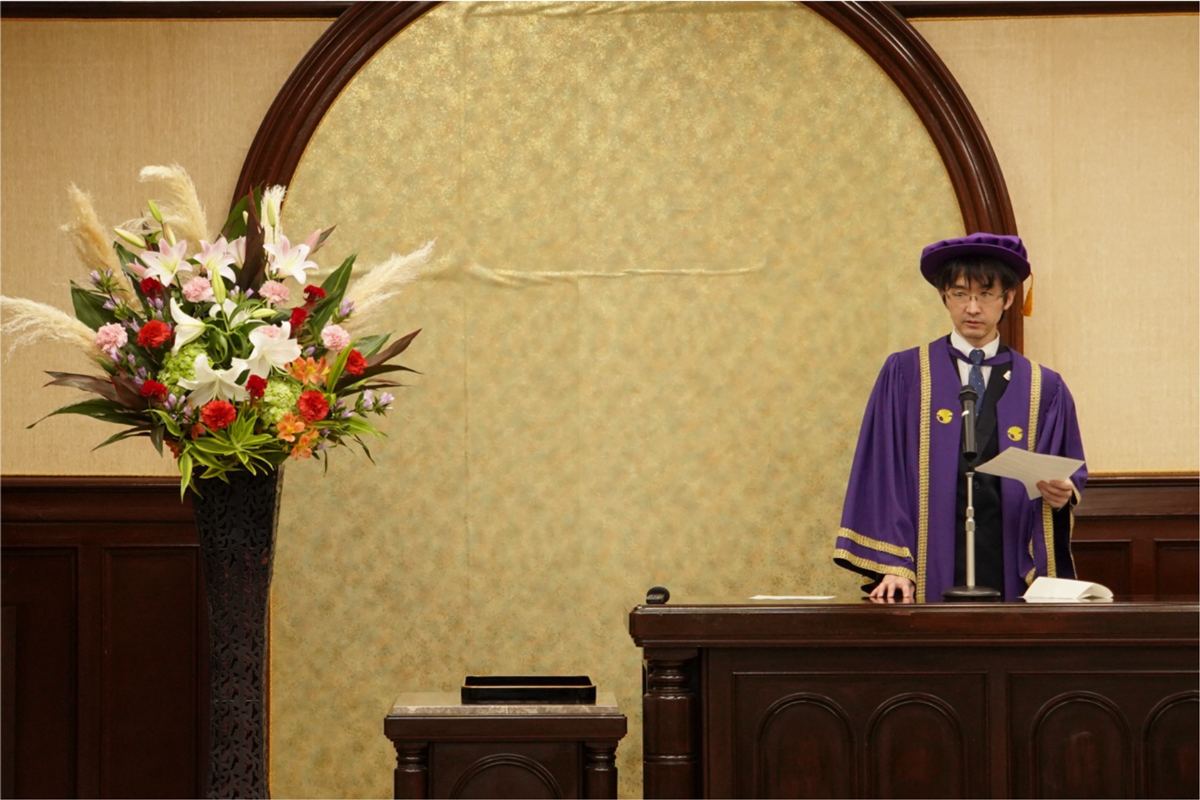
- Prof. Yasuyuki OZEKI, Director of Managing Committee,
Department of Advanced Interdisciplinary Studies, Graduate School of Engineering, The University of Tokyo
Professor Masakazu SUGIYAMA (Energy System), Director of the Research Center for Advanced Science and Technology, The University of Tokyo, also offered congratulatory remarks to the graduates.
After congratulating them on their remarkable achievement, Prof. Sugiyama presented them with another challenge. Having received their PhD degrees from the Department of Advanced Interdisciplinary Studies, they had achieved research that did not belong to one specific discipline but rather reached across multiple disciplines. He then asked, “Is it enough just to be interdisciplinary?”
“In my opinion, the next challenge is to try to become transdisciplinary.” Prof. Sugiyama described being interdisciplinary as existing between multiple disciplines, while being transdisciplinary means “going beyond the existing walls or barriers between different disciplines.” He encouraged the graduates to enter different fields, cross those barriers, and continue their quest for new insights.
Prof. Sugiyama also reminded the graduates that “you are not alone.” During their PhD studies, they had collaborated with members of their laboratories and external collaborators and had been encouraged by friends and families. For their next challenge—crossing barriers, transcending academic boundaries, and beginning a new journey in a new field—he stressed the importance of finding good colleagues who could collaborate with them. He also told them that it would become increasingly important “to convey your enthusiasm.”
He then turned to the role and limitations of science and technology. Academic and engineering activities, he said, cultivate new knowledge, new technology, and new methodologies to enlarge or extend human capabilities. At the same time, he asked the graduates to “be conscious of the limitations of science and technology.”
Prof. Sugiyama asked whether human beings would eventually be able to understand everything that exists in the world—human beings themselves, our surroundings, our planet, and the cosmos. His own answer, he said, was that it would be extremely difficult, although not necessarily impossible. For that reason, “we should be more or less humble regarding the limitations of our knowledge.”
He explained that our knowledge and technology are still incomplete and that we need to imagine what may lie between the things we already know, or even “extrapolate our thinking beyond the collection of knowledge and technology that we currently possess.” “That, in my opinion, is ethics itself,” he said.
Prof. Sugiyama further described ethics related to science and technology as “thinking toward the future”: imagining both the positive and negative impacts that our current science and technology may have over time. He emphasized the importance of our emotions and empathy as living beings, saying that instincts and emotions may sometimes give us warnings or insights more clearly and rapidly than logic alone.
As another important point, he urged the graduates to “reflect on history.” History can tell us many things, including why and how human beings have killed one another, what kinds of weapons they have used, and how devastating disasters might have been avoided. At the same time, he noted that history depends greatly on narratives, and that different people may have completely different narratives concerning the same historical facts.
The objective attitude needed when reflecting on history, he said, is exactly one of the skills the graduates have acquired through their scientific training. While science is not perfect and there may be multiple ways of describing nature, he said that science is “probably the best objective approach that human beings have developed, compared with other ways of thinking.”
Prof. Sugiyama concluded by encouraging the graduates to apply this objective way of thinking when reflecting on the past and projecting their thoughts into the future, and to discuss and collaborate with colleagues to make the world more sustainable and more capable of maintaining and enhancing our well-being.
“I hope that you will achieve even greater success through your continued efforts to transcend academic barriers,” he said. “So let us continue such transdisciplinary endeavors.”
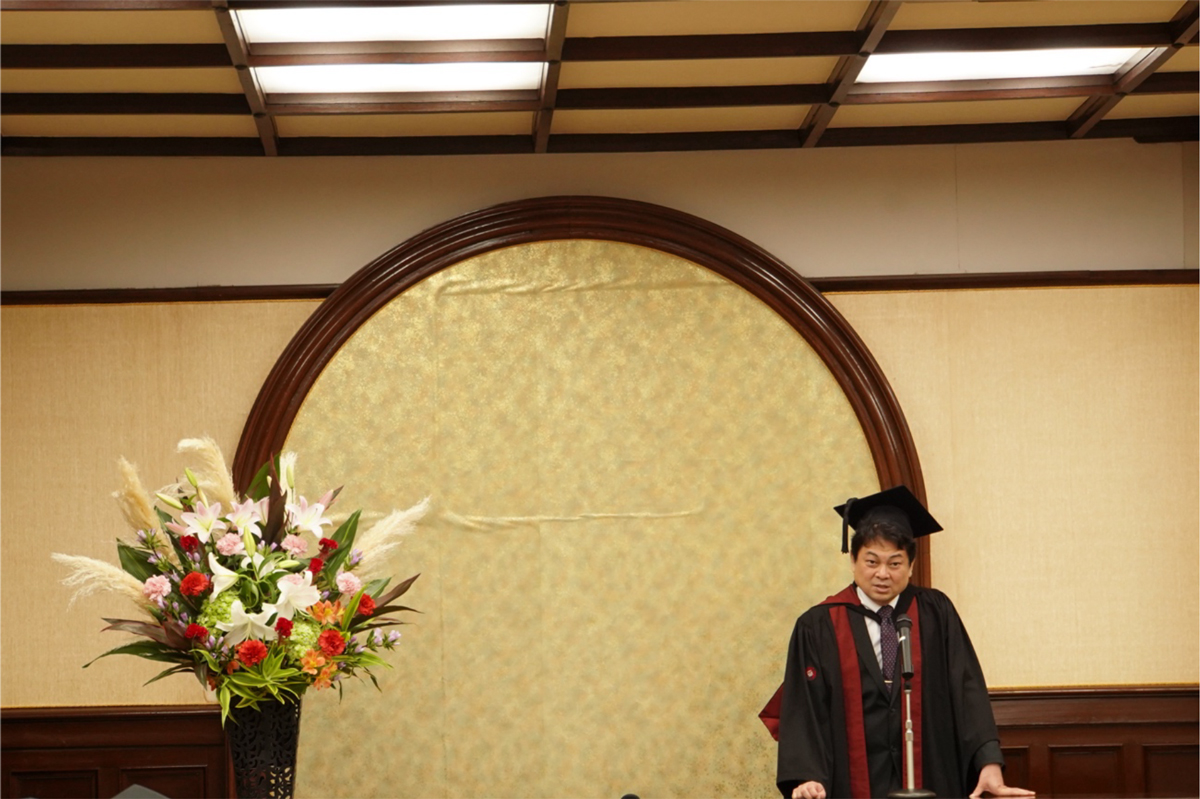
- Prof. Masakazu SUGIYAMA, Director of the Research Center for Advanced Science and Technology, The University of Tokyo
