

- HOME
- NEWS
- RCAST Report
- 2026 Autumn Semester Matriculation Ceremony of Advanced Interdisciplinary Studies
2026 Autumn Semester Matriculation Ceremony of Advanced Interdisciplinary Studies
- RCAST Report
October 15, 2026
On Thursday, October 1, the Autumn Semester Matriculation Ceremony of the Department of Advanced Interdisciplinary Studies, Graduate School of Engineering, the University of Tokyo, was held.
The ceremony began with an address by Professor Yasuyuki OZEKI (Photonic Imaging), Director of Managing Committee, Department of Advanced Interdisciplinary Studies.
Prof. Ozeki spoke about how scientific and technological progress is opening new possibilities for how we live, learn, and conduct research, and how artificial intelligence is becoming a part of our everyday work. He went on to explain that advances in AI depend not only on computer science but also on semiconductors, materials, reliable energy supplies, and public policies that guide its use, and that realizing the benefits of new technologies requires people with different kinds of expertise to work together. In an age when AI makes information more accessible, he noted the importance of deepening one’s own expertise, which enables researchers to evaluate evidence, identify meaningful questions, and contribute their own insights to discussions across disciplines.
Prof. Ozeki also addressed the importance of asking questions, referring to the Japanese proverb, “To ask is a temporary embarrassment. Not to ask is a lifelong embarrassment.” AI has made it easier to ask about unfamiliar subjects, but he noted that conversation with another person can offer opportunities that AI cannot. By asking a researcher directly, students can learn why a problem matters to them, what they find difficult, and what excites them about their work. A simple question from someone in another field can open a new direction of thought and sometimes become the beginning of a collaboration. He encouraged the students to remain curious, ask freely, and learn from one another.
Professor Masakazu SUGIYAMA(Energy System), Director of the Research Center for Advanced Science and Technology (RCAST), emphasized the importance of being a specialist who can respect specialists working in a different field. A specialist, he explained, is not one who just knows existing knowledge, but one who can find something forgotten or dismissed in an academic field and find out something new, something nobody has seen. He identified this as a competence that students need to cultivate during their PhD candidate course. He also added that a network of human talents and the ability to communicate deeply among specialists in different fields would be the real achievement of the interdisciplinary approach.
Prof. Sugiyama then spoke about the “unique antenna” needed to find out something new behind a bunch of knowledge which already exists. He said that behind a sufficient answer from AI, students need to find out that something is missing. He described the ability to find beautiful things, beautiful scenery, and beautiful conversation among colleagues as a “sense of beauty,” and said that such a sense may allow for the real finding of something new. He encouraged the students to cultivate this sense, especially in the era of AI, expressing his hope that it would enrich their scientific journey, society, and RCAST itself.
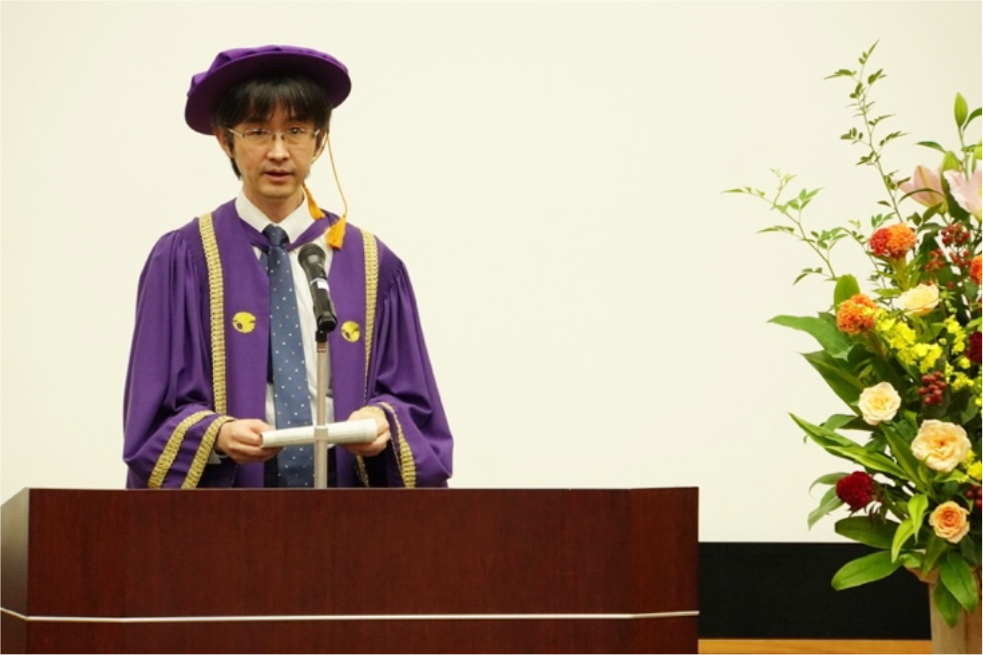
Prof. Yasuyuki OZEKI, Director of Managing Committee, Department of Advanced Interdisciplinary Studies, addressing the incoming students
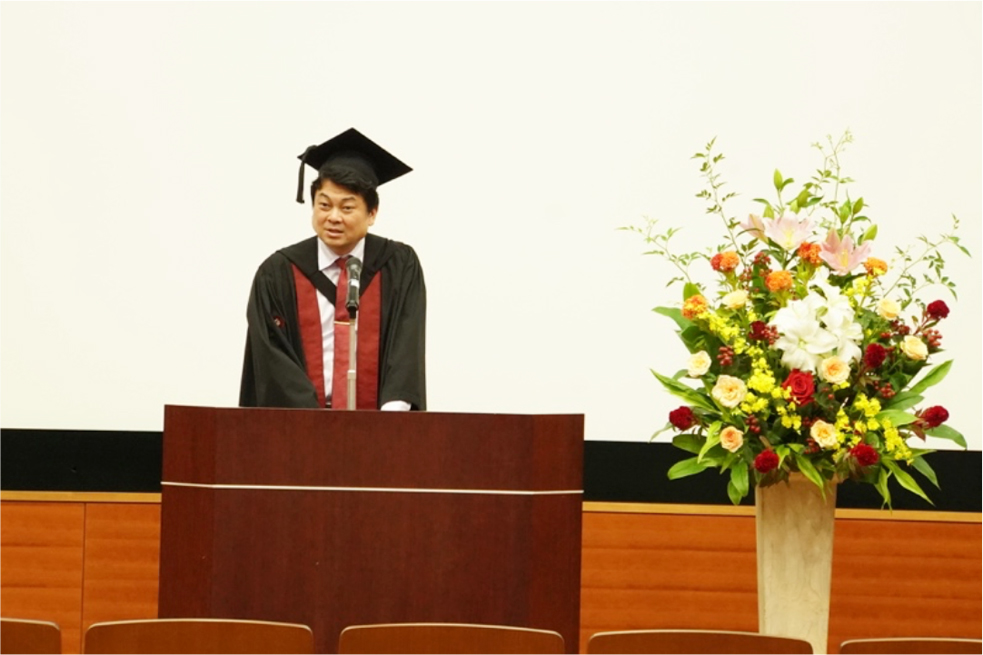
Prof. Masakazu SUGIYAMA, Director of the Research Center for Advanced Science and Technology, speaking to the incoming students
