

- HOME
- Research
- Researcher's Profile
- Sho YAGISHITA
Researcher's Profile

- Professor
- Sho YAGISHITA
- Cellular Neurophysiology
- syagishita
 g.ecc.u-tokyo.ac.jp
Biography
| March 2008 | Graduated from Faculty of Medicine, The University of Tokyo |
|---|---|
| April 2008 | Junior Resident, Ibaraki Prefectural Central Hospital |
| April 2009 | Junior Resident, The University of Tokyo Hospital |
| April 2010 | Graduate School of Medicine, The University of Tokyo |
| April 2011 | JSPS DC1 Research Fellowship |
| April 2013 | Project Assistant Professor, Graduate School of Medicine, The University of Tokyo |
| April 2016 | Assistant Professor, Graduate School of Medicine, The University of Tokyo | September 2016 | PhD (Medicine), The University of Tokyo | May 2018 | Lecturer, Graduate School of Medicine, The University of Tokyo | June 2026 | Professor, RCAST, The University of Tokyo |
Research Interests
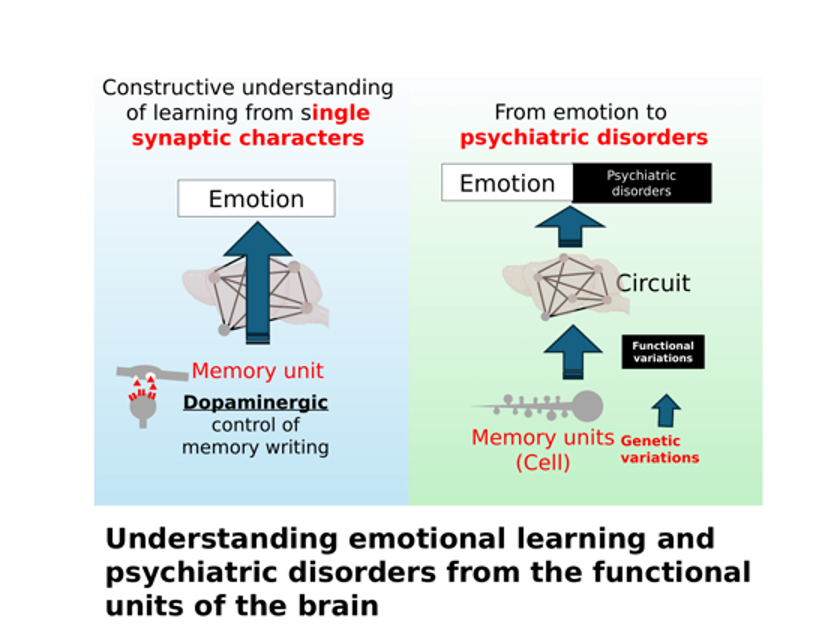
Advanced brain functions emerge from intricate neural networks. Our laboratory focuses on the "functional units" constituting these networks, specifically synapses, which integrate information and act as memory units. The coordination of these diverse units enables functions like learning, memory, and emotion. The decisive difference between biological brains and artificial neural networks lies in the inherent complexity and diversity of these functional units.
To explore how these units operate, we experimentally reproduce in vivo complex signal processing mechanisms within brain preparations. Utilizing cutting-edge imaging technologies such as two-photon excitation microscopy, we investigate dynamics ranging from single functional units to the neuronal network. By elucidating the behavioral significance of these properties, we advance multi-layered research connecting molecules, cells, and behaviors. We are particularly interested in how monoamines (such as dopamine and serotonin) and immune system cytokines act upon these functional units.
Furthermore, we aim to unravel the mechanisms underlying psychiatric disorders. These disorders are complex conditions arising "between society and the brain" through gene-environment interactions. Brain functional units exhibit individual differences based on development and experience. We hypothesize that psychiatric disturbances can be best understood as a "mismatch" between these "individual traits" and the processing demands required by the environment. By verifying this hypothesis using animal models, we will advance translational research to connect these findings to the elucidation of human pathology.
Award
- 2015 Best Paper Award, Japanese Neural Network Society
- 2015 Young Researcher Award, Asia Pacific Neural Network Assembly (APNNA)
- 2022 Encouragement Award, The Japan Neuroscience Society
- 2023 Best Teacher’s Award, Faculty of Medicine, The University of Tokyo
- January 2026 AMED President Award, Japan Healthcare Research and Development Grand Prize
Keywords
Emotional learning, synaptic plasticity, monoamine, psychiatric disorders
Educational Systems
- Department of Advanced Interdisciplinary Studies, Graduate School of Engineering
