

- HOME
- Research
- Research Category
- High performance Materials Shiraiwa Laboratory
High performance Materials
Shiraiwa Laboratory
From Fracture Mechanisms to Materials Design
Fracture of materials is a hierarchical phenomenon in which microscale deformation and damage gradually accumulate within the internal microstructure and eventually lead to macroscopic failure. Understanding when, where, and why fracture initiates is the key to using materials safely up to their limits, and it forms the foundation for the reliable use of structural materials in society. Our laboratory integrates mechanical testing, in-situ observation, numerical simulation, and data science to elucidate the fracture mechanisms that connect microscopic events to macroscopic behavior. By feeding these insights back into materials design, we aim to enhance the reliability of structural materials that support automotive, aerospace, and infrastructure applications.
In-Situ Measurement of Microscale Deformation and Damage
The microscopic events that trigger fracture occur locally and within very short time scales, making their observation a major challenge. We have developed an in-situ measurement system that integrates digital image correlation (DIC), acoustic emission (AE), and high-speed imaging, achieving nanometer-scale displacement sensitivity and sub-microsecond temporal resolution. With this system, we have successfully captured, for the first time, instantaneous phenomena such as twinning and kink-band formation in real time. By further combining AE waveform analysis with machine learning, we are developing techniques to quantitatively identify invisible events such as microcrack initiation and phase transformations.
Materials Design through Simulation and Data Science
To translate experimental insights into predictive design, we develop numerical frameworks based on the crystal plasticity finite element method (CPFEM). Constitutive models that incorporate twinning, phase transformation, and damage processes allow us to predict strength, ductility, and fatigue properties as functions of microstructure. Furthermore, large microstructure–property datasets generated through CPFEM-based virtual experiments are analyzed using machine learning and Bayesian optimization to automatically search for microstructures that overcome the strength–ductility trade-off. This framework also extends to metal additive manufacturing (AM), where AE monitoring with deep learning enables real-time defect detection and CPFEM analysis predicts the mechanical properties of as-built components, contributing to the improved reliability of AM-fabricated parts.
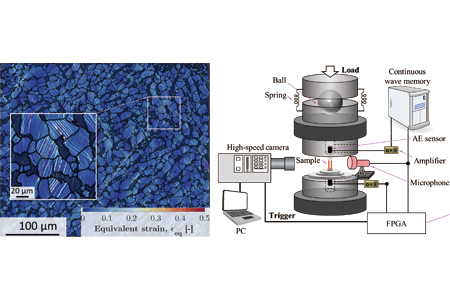
In-situ measurement system for microscale strain mapping
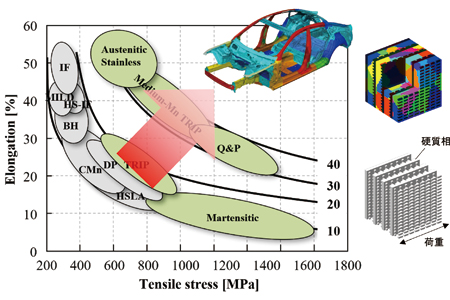
Microstructure exploration to overcome the strength–ductility trade-off
Ever since I was a child, I have been fascinated by “crafting” and “alchemy” in games. It was not so much the fantasy worlds themselves that drew me in, but rather the system in which combining one material with another could produce, quite suddenly, a powerful item that was more than the simple sum of its parts. Unexpected combinations can give rise to distinctive properties. That feeling may have been the starting point of my interest in materials engineering.
The same is true of structural materials. Even slight differences in the combination of elements, or in the conditions of processing and heat treatment, can greatly affect a material’ s strength and resistance to fracture. This is because the internal microstructure of a material determines where deformation becomes concentrated, where cracks begin to form, and how the material ultimately fails.
Today, together with my students, I am working to clarify the relationship between such microscopic changes and the visible properties of materials through observation and measurement, simulation, and data science.
Member

-
- Associate Professor
Takayuki SHIRAIWA
Research Area: Mechanics of materials, Fracture mechanics, Non-destructive evaluation, Materials reliability, Materials informatics - Associate Professor
Laboratory Homepage
Tags
