

- HOME
- Research
- Research Category
- Cellular Neurophysiology Yagishita Laboratory
Cellular Neurophysiology
Yagishita Laboratory
Understanding emotional learning and psychiatric disorders from the functional units of the brain
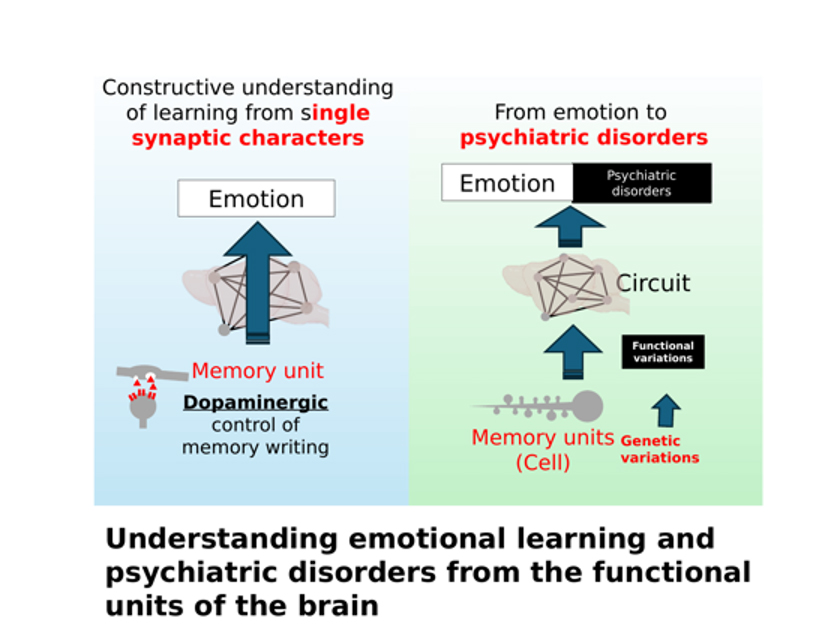
Brain functions are generated by complex circuits formed by neurons. In particular, the junctions between neurons, named "synapses", are crucial functional elements with distinct properties depending on the brain region, and their collective activity gives rise to higher-order brain functions. The inherent complexity and diversity of these biological functional units represent a fundamental distinction from artificial neural network models. Our goal is to understand the brain through the lens of these functional elements, and to elucidate how alterations in their properties lead to brain dysfunctions, including psychiatric disorders.
Multi-Scale Research: From Single Synapses to Behavior
In our laboratory, we utilize cutting-edge technologies, such as two-photon excitation microscopy, to meticulously unravel how individual synapses operate as functional units and how their ensembles exhibit cellular-level characteristics. We conduct multi-layered research that bridges molecules, cells, and behavior, ranging from elucidating the molecular basis that shapes these cellular functions to understanding their behavioral significance in individual organisms. We focus particularly on the actions of monoamines including dopamine and serotonin, which regulate learning and motivation, as well as the effects of the immune system, including cytokines, whose critical role in brain function has gained significant attention in recent years.
Understanding Psychiatric Disorders through Brain Functional Elements
Psychiatric disorders, many of which have long remained poorly understood, are challenging to grasp because they arise from the complex interaction between genetics and the environment—essentially manifesting as disorders born "between society and the brain." Using animal models, we dissect and examine how mismatches of brain functional elements and given environmental characteristics lead to disabilities. We actively promote translational research that tackles the challenging question of how to bridge insights gained from animal models to a deeper understanding of the human mind and pathology.
We will be launching our laboratory at RCAST in 2026. Having conducted research for many years at the Graduate School of Medicine, we very much look forward to pursuing our work in the environment of RCAST, where experts from a wide range of fields gather beyond the conventional boundaries of biomedical science. After entering the University of Tokyo, it was at RCAST that Yanagishita first learned basic biological experiments, such as the culturing of E. coli. At the same time, RCAST was home to a diverse array of research activities, including laboratories in knowledge science, and was filled with the intellectual energy of interdisciplinary exchange. I still vividly remember how exciting that atmosphere felt.
I am truly delighted to be able to return to this memorable place, to once again receive intellectual stimulation myself, and to devote myself, together with younger researchers, to the creation of new knowledge. Building on the foundation of our medical research to date, we hope to develop interdisciplinary research that is uniquely possible at RCAST.
Member

-
- Professor
Sho YAGISHITA
Research Area: Neuroscinece - Professor
