

- HOME
- NEWS
- RCAST Report
- Turning waste plastic into useful diacids — with just water and oxygen ―A new process breaks down plastic without any catalyst; a life-cycle assessment finds it can reduce carbon emissions―
Turning waste plastic into useful diacids — with just water and oxygen
―A new process breaks down plastic without any catalyst; a life-cycle assessment finds it can reduce carbon emissions―
- Research News
July 16, 2026
Key Points
- A new, catalyst-free process converts hard-to-recycle plastics — including polyethylene, rubber and dirty mixed waste — into valuable diacids such as succinic acid, using only water, oxygen and heat.
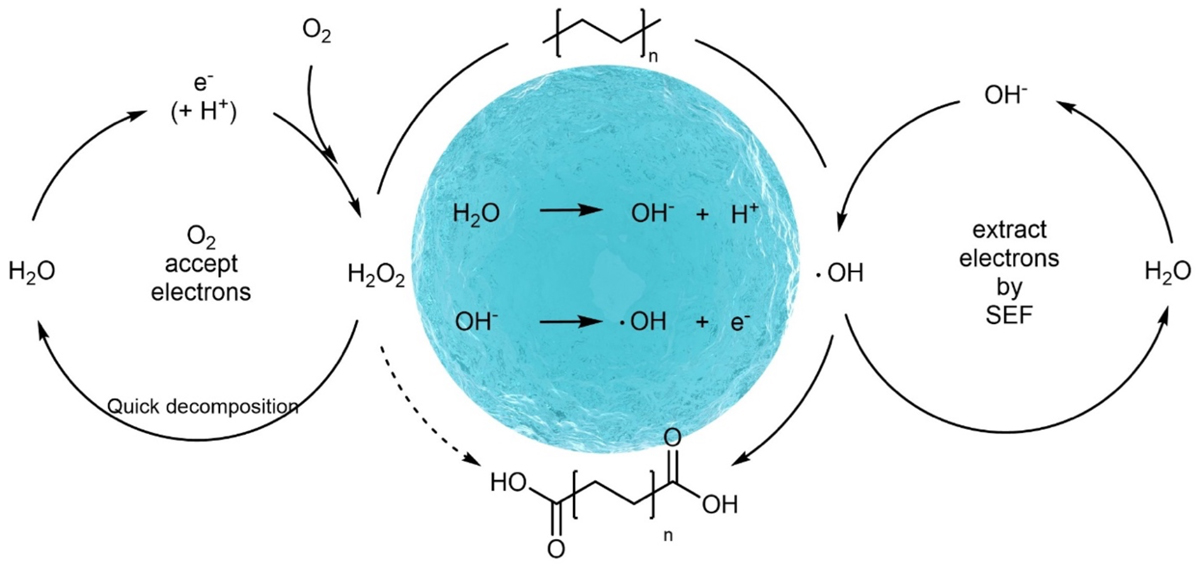
- Reactions at the surface of tiny water microdroplets generate reactive species from the water itself and cleave the plastic chains. Because no catalyst is used, there is nothing for impurities to “poison” — the key novelty of the work.
- A life-cycle assessment led by the University of Tokyo indicates the process can achieve a net reduction of about 0.30 kg of CO₂ per kilogram of plastic and works even on dirty mixed waste, pointing to a promising new recycling route.
Overview
The world makes far more plastic waste than it can handle. In 2019 alone, about 353 million tonnes were thrown away, and nearly half went to landfill. A team from Zhejiang University (China), the University of Tokyo and Cardiff University (U.K.) has found a simple way to turn some of the hardest-to-recycle plastics — including polyethylene, rubber and dirty mixed waste — into valuable diacids (Note 1). The work is published in Nature.
The surprising part: it uses no catalyst — just water, oxygen and heat. When melted plastic is stirred in hot water, it breaks into tiny droplets whose surfaces act as natural chemical reactors, generating reactive species from the water itself. These cut the long plastic chains into short, useful diacids such as succinic acid. The reaction works even in tap water and seawater, and the team has already scaled it up to 300 grams.
The team also assessed the environmental side. Even under cautious (conservative) assumptions, a life-cycle assessment (Note 2) shows the process releases fewer greenhouse gases than incineration or landfill and is roughly as clean as mechanical recycling. Because it can also handle dirty, mixed waste, it is a promising new option for plastics that are normally too hard to recycle.
Research Details
Most chemical methods for turning waste plastic into something useful rely on a catalyst — a material that speeds up the breakdown. But real waste is dirty: it contains dyes, additives and grime that clog and “poison” catalysts, so most methods require expensive cleaning and sorting first, and many never make it out of the lab. This team avoided the problem by removing the catalyst altogether. “If there’s no catalyst, there’s nothing to poison,” said Prof. Yong Wang of Zhejiang University. “The water does the work.”
The idea draws on a striking fact discovered in recent years: water broken into very small droplets behaves differently from water in a glass. At a droplet’s edge, very strong electric fields can pull the water apart and create reactive species on their own — with no chemicals added. The team realised that melted plastic stirred in water would break into countless tiny droplets, and the reactions at their surfaces could attack the plastic directly. Under mild conditions — around 125 °C — polyethylene turned mostly into short diacids, with succinic acid as the main product, and a series of tests confirmed that water is the key ingredient driving the reaction.
The same approach worked on many different materials. Common polyethylene (used in gloves, bags and bottle caps) could be completely broken down, while polypropylene and polystyrene were converted into other useful acids. The method also handled more complex waste, including old tyres and metal-lined packaging, from which the aluminium layer was recovered as a solid, and common additives did not interfere. “We kept expecting the dirty samples to break it, and they didn’t,” said Ruiliang Gao of Zhejiang University. “Even using seawater, it just kept making diacids.” In a larger test, 300 grams of shredded plastic bags were converted in a 5-litre reactor and the products purified into diacids.
A techno-economic analysis suggests it could pay for itself. A medium-sized plant would cost about US$144 million to build, could earn roughly US$72 million a year, and pay for itself in about three years — without any subsidy. Because even a small plant could break even, the team says facilities could be built close to where waste is produced, rather than only in large central plants.
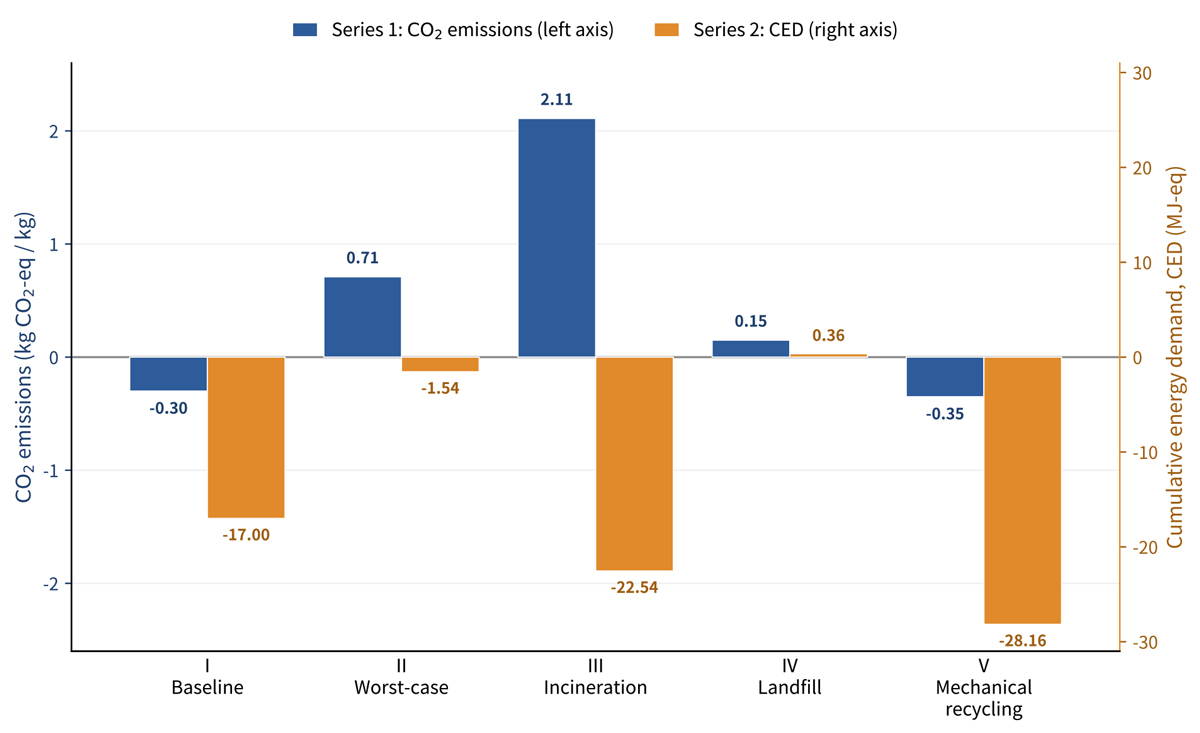
The heart of the environmental case is a life-cycle assessment carried out at the University of Tokyo, which measured the impact of treating one kilogram of waste plastic against the three usual options — mechanical recycling, incineration and landfill. Even with conservative estimates, treating one kilogram of plastic with this method leads to a net reduction of about 0.30 kg of CO₂; in other words, it prevents more greenhouse-gas emissions than it creates (on a substitution basis that credits emissions avoided by replacing conventional products). For comparison, burning the same plastic releases about 2.11 kg of CO₂, while landfill adds about 0.15 kg. The process performs similarly to mechanical recycling (which avoids about 0.35 kg of CO₂) but with an important advantage: mechanical recycling only works for clean, well-sorted plastics, whereas this method can handle dirty and mixed waste. “Our results show that a process able to handle dirty mixed waste can match the climate benefits usually achievable only by mechanical recycling — which works only on relatively clean, well-sorted plastic,” said Prof. Ichiro Daigo of RCAST, the University of Tokyo. “And it works on exactly the waste that recycling has to throw away.”
The picture on energy use is more mixed. The process clearly beats landfill, but incineration and mechanical recycling save a little more — because burning recovers energy directly and recycling avoids making new plastic. Even in a worst-case scenario, the process still produces less greenhouse gas than burning the plastic and still saves energy overall. The largest remaining impacts come from cooling, followed by the plastic input itself and then the oxygen supply — each a clear target for further improvement.
Beyond plastics, the team says this is the first realistic plan for taking “tiny droplet” chemistry out of the lab and into industry. Because it needs only water and oxygen and works even with seawater, they see it as a practical option for the regions that struggle most with plastic waste.
Related Information
Daigo Laboratory, RCAST, The University of Tokyo: https://park.itc.u-tokyo.ac.jp/daigo/en/
Researchers
Research Center for Advanced Science and Technology (RCAST), The University of Tokyo
Professor Ichiro Daigo
Department of Advanced Interdisciplinary Studies, Graduate School of Engineering, The University of Tokyo
Graduate student Hao Wang
* This work was conducted as an international collaboration with Zhejiang University (China), Cardiff University (U.K.) and others.
Publication Information
- Journal:
- Nature
- Title:
- Catalyst-free, microdroplet-mediated waste plastic conversion to diacids
- Authors:
- Ruiliang Gao, Liwei Zhang, Richard J. Lewis, Hao Wang, Zhiyan Pan, Yage Zhang, Zekai Yu, Zhiqiang Liu, Xiaolin Guo, Xiangbowen Du, Wencong Liu, Minghang Li, Shipan Liang, Bing Lu, Ichiro Daigo, Shanjun Mao, Graham J. Hutchings and Yong Wang
Glossary
- (Note 1) Diacid (dicarboxylic acid)
an organic acid bearing two carboxyl groups (–COOH). Succinic acid is one example; diacids are used as feedstocks for resins, pharmaceuticals and foods. - (Note 2) Life-cycle assessment (LCA)
a standard method for quantifying the full environmental impacts of a product or service, from resource extraction to disposal.
Contact Information
Research Center for Advanced Science and Technology (RCAST), The University of Tokyo
Professor Ichiro Daigo
Tags
