

- HOME
- Research
- Research Category
- Initiatives for Co-Creation of Inclusive Societies (Tojisha-Led Co-Production)Ayaya Laboratory
Initiatives for Co-Creation of Inclusive Societies (Tojisha-Led Co-Production)
Ayaya Laboratory
Solidarity and Co-Production Based on Neurodiversity
Neurodiverse Solidarity
Building on the principles of neurodiversity that emerged from the autism rights movement beginning in 1993, this research envisions a future in which neurodiverse people—including those in the majority—can live in solidarity rather than division, transcending differences in support needs, gender, and other factors. It also examines social conditions that deepen the divide between minorities and majorities, including low psychological safety in organizations and stigma—such as discrimination and prejudice—perpetuated by media and academia.
Academic Co-Production
With the global rise of participatory and user-led research, people with disabilities and those in minority positions, who have long been treated primarily as objects of research, are increasingly participating in academic research as active agents. However, various challenges remain, including tokenism, in which participation remains superficial or symbolic. This research explores these challenges and aims to build relationships between academic researchers and people with lived experience that enable genuinely equitable co-production.
Tojisha-Kenkyu Sharing
Our lab reinterprets Tojisha-Kenkyu, a practice unique to Japan, through the lens of epistemic injustice and positions it as a means of self-advocacy. In Tojisha-Kenkyu, minorities with similar lived experiences come together to share those experiences, through which they may give rise to and share ways of expressing and understanding forms of difficulty specific to minority experiences—ways that do not yet exist in majority society. On this basis, we aim to implement Tojisha-Kenkyu in organizations and local communities, both in Japan and internationally, for a wide range of people, from marginalized minorities to majority populations.
Current Priority Issue: Body-Level Communication and Information Accessibility
At present, we are particularly focusing on the fact that autistic people with high support needs remain insufficiently supported within the norms of majority society in two key respects. First, there is a lack of attention to “body-level communication through means other than spoken language”: that is, communication through bodily states and expressions, such as having one’s bodily discomfort noticed and responded to, and having the various non-spoken words or expressions emitted by the whole body received by others. Second, there is a lack of “information accessibility”: that is, the provision of information, in forms suited to each person, that enables temporal and spatial predictability. In our laboratory, we understand this “body-level communication” and “information accessibility” as essential means through which individuals connect with their own bodies, their environments, and society, and we aim to implement these perspectives in support settings and local communities.
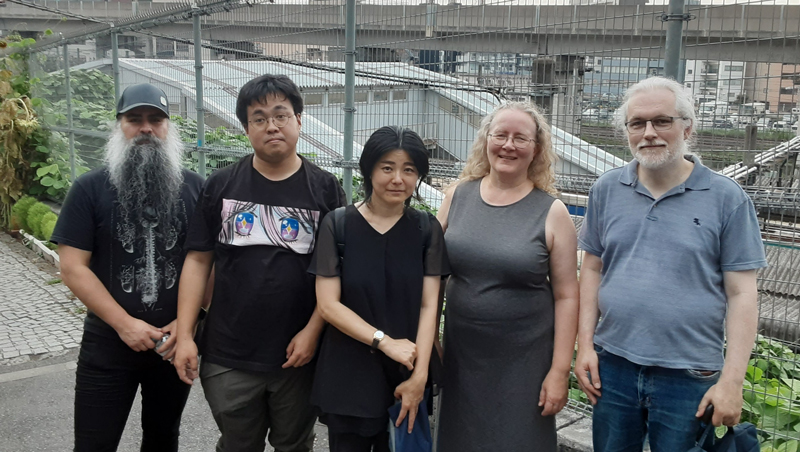
International symposium with autistic peers from around the world
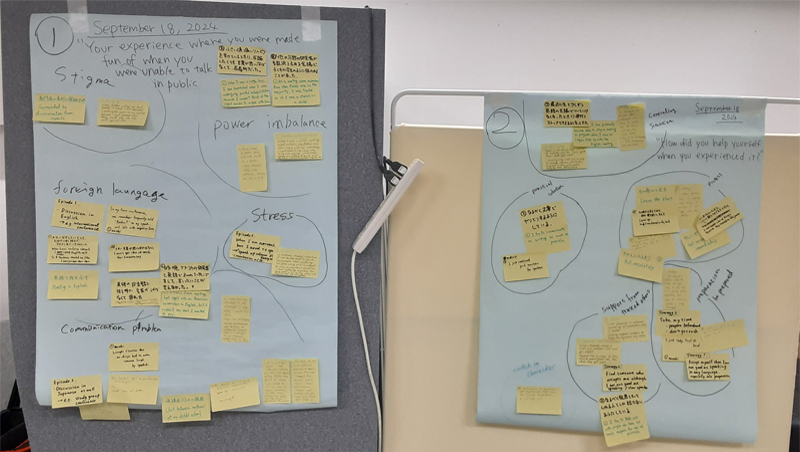
Tojisha-Kenkyu bringing together people from different countries and with different disabilities
One phrase often heard in support settings is, “I cannot communicate with non-speaking children.” However, human communication is not limited to spoken language. By crying, screaming, refusing to move to express rejection, or expressing anxiety through an increased heart rate, rapid breathing, cold hands and feet, or perspiration, we communicate in many ways through our whole bodies, beyond spoken language. I hope we will place greater value on communicating through our bodies.
Another phrase often heard is, “Once children leave school, they will no longer receive the kind of comprehensive support available at school. Therefore, they must be trained to manage without support.” However, communication and information support is not like the training wheels on a bicycle, something to be removed someday. Rather, it is like a pair of glasses, something that is needed all the time in order to access information that would otherwise be inaccessible. I hope that the perspective of identifying the supports each child needs while they are at school, and enabling them to participate in society with those supports in place, will help transform society as a whole.
Member

-
- Professor
Satsuki AYAYA
Research Area: Tojisha-Kenkyu, Tojisha-Led Research - Professor
Laboratory Homepage
Tags
