

- HOME
- Research
- Research Category
- Socio-metabolic systemsDaigo Laboratory
Socio-metabolic systems
Daigo Laboratory
The metabolism of resources and energy is analyzed to design a society that supports the well-being of both people and the planet.
Our society is driven by the “metabolism” of resources and energy. Our laboratory aims to scientifically elucidate these mechanisms and facilitate the transition to a society that achieves planetary health.
Analysis and Design of Socio-metabolic Systems
Society is regarded as a system that metabolizes materials and energy, and the flows and stocks of these materials and energy are quantitatively analyzed from resource extraction through product use, disposal, and recycling. Although the materials and energy inputs to our society are derived from non-renewable natural resources, they have yet to be utilized sustainably. By visualizing the interconnections among material stocks, infrastructure, energy use, and human activities, we aim to design socio-metabolic systems that achieve both Planetary Health and human well-being.
Sustainable Material Recycling Systems
Material recycling systems shall be advanced to support the circular economy: we focus on metals such as steel and non-ferrous metals. The properties of recycled metals depends on the quality of metal scrap, which follows how to use and recover the metals in a society. Because the current conditions of metal scrap are not recognized, we experimentally observe and measure scrap characteristics. The obtained data are used for a deep-learning-based analysis to estimate the characteristics of scrap without experiments. By integrating materials science with socio-system analysis, we investigate the behavior of impurity elements (tramp elements) mixed into steel scrap and establish a new discipline for producing high-grade steel while tolerating such impurities.
Future Society Design through Life Cycle Thinking
While a conventional life cycle assessment (LCA) evaluates the environmental impacts of products and technologies under current conditions, we conduct a future-oriented LCA that considers potential constraints on resources and energy, as well as possible changes in institutions and society. Many sectors are interrelated in developing a sustainable society, where they are required to consider the effects of their behavior on other sectors. We propose approaches to enhance the overall utility in society based on life cycle thinking while considering inter-sectoral industrial cooperation and the consumers. We develop methodologies for designing technologies, industries, and socio-technical systems for sustainable future societies.
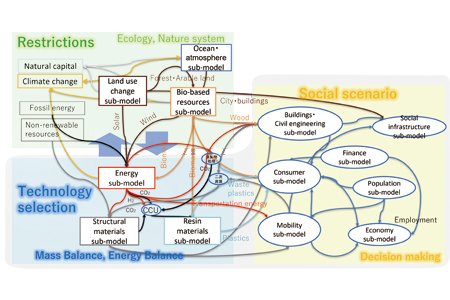
Schematic illustration of the socio-metabolic system model
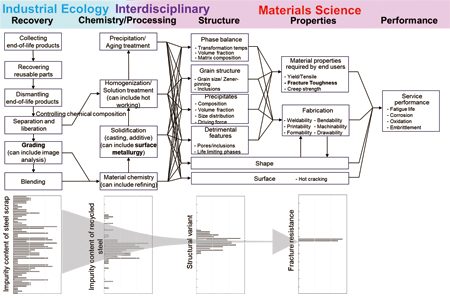
R-PSPP framework for designing material production chains from secondary resources with enhanced robustness against variability
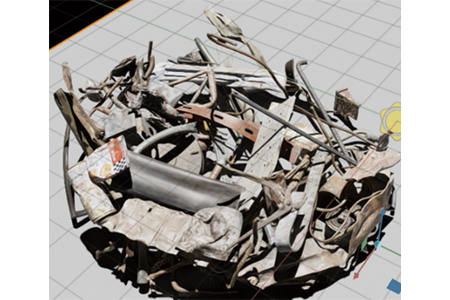
Steel scrap pile in a virtual space
When I was a university student, the Kyoto Protocol was adopted, and I became interested in working to contribute to solving global environmental issues. Since I was studying materials engineering, I began to think about ways to continue using materials (especially metals) without environmental impacts. At the time, very few researchers were approaching this social problem analytically using mathematical models, so I was happy to be able to place myself at the dawn of a new research field. On the other hand, I had a hard time modeling the phenomenon, because I often did not have the necessary data. In order to obtain the necessary data, I did whatever it took to fulfill my objective, whether it was experiments or field studies, without being particular about the method. I am sure that my character of not giving up and being optimistic suited me well. Nowadays, carbon neutrality and the circular economy are recognized as important social issues, and I feel that we are a world apart from when I started my research.
Member

-
- Professor
Ichiro DAIGO
Research Area: Industrial Ecology, Life Cycle Assessment, Material Flow Analysis - Professor
Laboratory Homepage
Tags
