

- HOME
- Research
- Research Category
- Sol-X International Collaboration Lab
Sol-X International Collaboration Lab
Toward a Sustainable and Carbon-Neutral Society Powered by Solar Energy
To promote academic and practical research that contributes to solving global energy and environmental challenges, the research fields of photovoltaics, hydrogen-related technologies, and life-cycle assessment at the Research Center for Advanced Science and Technology are working collaboratively. Through the establishment of international joint research hubs with globally promising research institutions and universities called “Sol-X International Collaboration Lab”, including the French National Centre for Scientific Research (CNRS) and the University of Bordeaux, we are striving to generate impactful research outcomes.
Solar Power Generation and Related Themes
New semiconductor materials and quantum nanostructures are exploited in order to achieve photovoltaic solar energy conversion reaching 50% efficiency. Research target includes: (1) Intermediate band solar cell with photocurrent enhancement by two-step infrared photon absorption using quantum dot arrays, (2) Multi-junction solar cells with improved solar spectral matching using stacked semiconductor junctions, and (3) Hot carrier solar cells with high output voltage via high energy carrier extraction. More recently, thermophotovoltaic (TPV) power generation system is investigated, in which solar energy is first converted to heat which in turn is converted into light of specific wavelengths (thermal radiation) to generate electricity using solar cells.
Solar Energy to Fuels and Related Topics
Photoelectrochemical cells enable the simple production of hydrogen using sunlight. Our research particularly focuses on the photoelectrodes, which form the core of these systems. In addition to developing new materials, we work on constructing functional structures that contribute to higher efficiency. Furthermore, we develop and employ semiconductor device simulations and in situ measurement techniques to elucidate the mechanisms of photocatalysts and photoelectrodes.
Life Cycle Assessment of Solar Energy Systems
We conduct research not only on various solar energy conversion technologies, but also on life-cycle thinking that encompasses the recycling of end-of-life systems, as well as environmental impact assessment methodologies for these technologies and products based on life-cycle assessment. For example, glass materials, which account for approximately 70% of the weight of photovoltaic panels, are currently difficult to recover and recycle. Therefore, it is desirable to establish treatment and recycling methods before large volumes of photovoltaic panels reach their end of life in the near future. Although various treatment technologies for end-of-life photovoltaic panels have already been proposed, systematic evaluation of these technologies is still required.
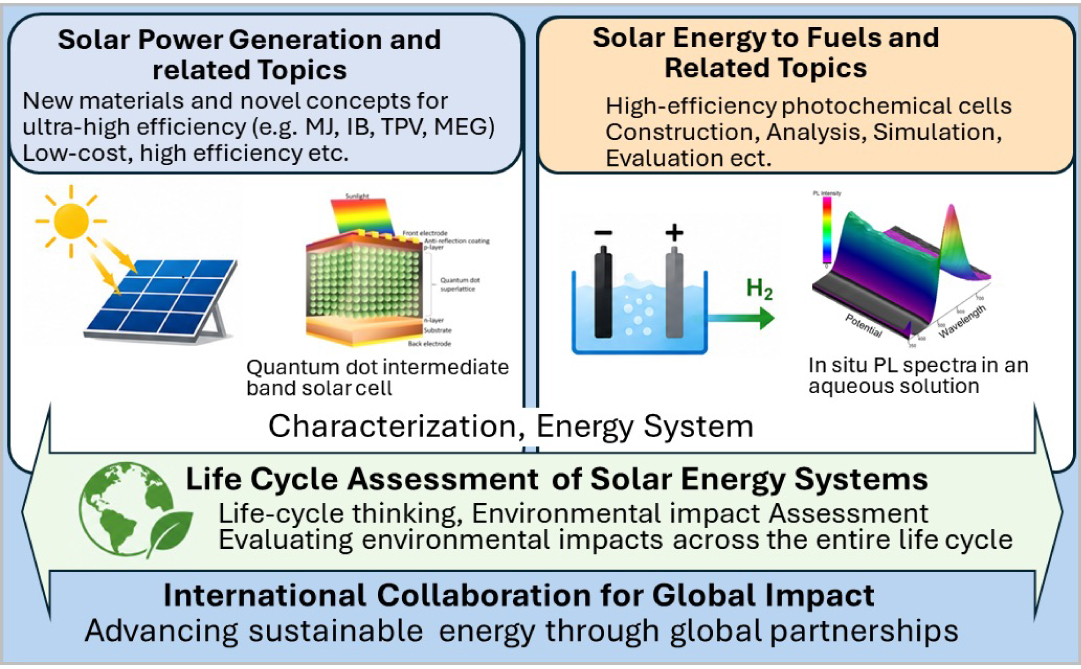
Sol-X Vision and Concept
Member

-
- Professor
Ichiro DAIGO
Research Area: Industrial Ecology, Life Cycle Assessment, Material Flow Analysis - Professor
<As of July 2026>
Tags
